
Quick-Question-Corner: Geometry and P.O.E.
Topic: Solving Geometry problems in under a minute using POE and Triangle Rules
Welcome readers! I'm taking a little time today to walk through a problem submitted by one of my students this week. It's a Geometry problem that's also a bit of a Word Problem. The original is an official ETS practice question available online on multiple forums and test preparation sites - all licensure and credit due to them.
What motivated me to write this one up was realizing that this is exactly the kind of problem which I can provide my students with the most assistance. How do I mean? Specifically, it's the kind of problem that's fast and simple if you know 1) about Congruent Triangle rules and 2) how to do process of elimination (POE) properly on multiple-choice tests, but long, tedious, and prone to errors if you don't.
I find that if my students haven't yet been exposed to this kind of question, it takes them too long and risks losing points on a practice or real GRE. But on the other hand, if my students get the right formulas and practice POE strategies, they win back an average of 4 minutes per section on the GRE - which is huge, considering the first two non-essay sections are 18 minutes and the second two are 23 minutes apiece. That's a lot of extra time you can use to complete other problems or review your answers!
Anyway, back to the problem, which is as follows:
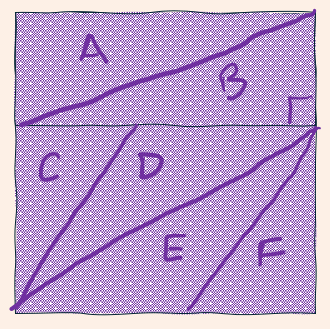
Text: The square region above has area 64 and is divided into six nonoverlapping triangular regions. If the area of triangular region A is 8, then the area of which of the following regions CANNOT be found?
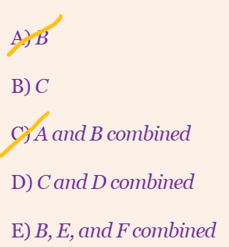
A) B
B) C
C) A and B combined
D) C and D combined
E) B, E, and F combined
I'm going to start simply by providing the explanation of how to do this in 30 seconds. The in-depth explanation with rules and strategies will follow, if you’re stuck on one point or want to check it out.
Quick-Question-Corner #1 (inspired by ETS Geometry problem Figure 42)
Quick Solution
What kind of problem this is:
Geometry (polygons), visual diagram, negative case ("CANNOT")
What you need to know to solve:
Congruent Triangle rules, POE strategies
Solving the problem in 30 seconds:
Given Area(□S) = 64 and Area(△A) = 8 and △B is a right triangle:
△A = △B because □R (the shape defined by △A + △B) is a rectangle.
If △A = 8 and △A = △B, area of △B = 8. △A + △B = 16.
If △B = 8, eliminate (A) and (C).
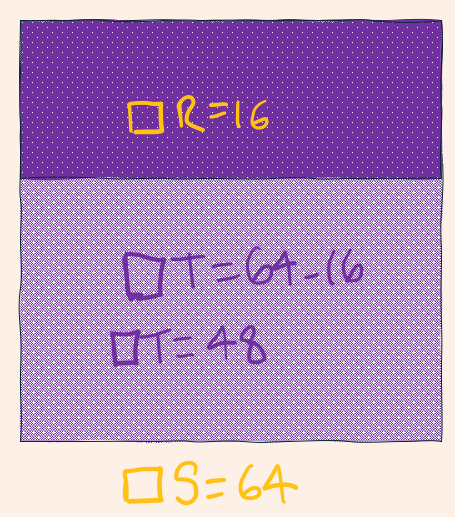
□T = □S - □R = 64 - 16 = 48.
△CD = △EF = (48 / 2 = 24).
Eliminate (D) and (E).
Side length of △C cannot be found.
Choice is (B), △C.
…Okay but WHY?
You might be feeling stuck or confused by the steps I laid out. If you are, worry not! From this point, I’ll go into more depth with explanations. If everything makes sense and you instead want to skip ahead to some general advice for GRE Quantitative problem-solving, find the next gold-letter section head or CTRL+F “Problem-Solving Tips”.
Detailed Solution
We are given this information: △A is a triangle with area 8. □S is a square with area 64. △B is a right triangle.
1. △A = △B.
Why? Right Angles. We know the rectangle □R formed with △A and △B is a rectangle because it has one right angle shown and is inset (shares angles and side segments) within a square □S, which has 4 right angles. If 3 of the angles are right angles, the 4th one has to be right angled too.
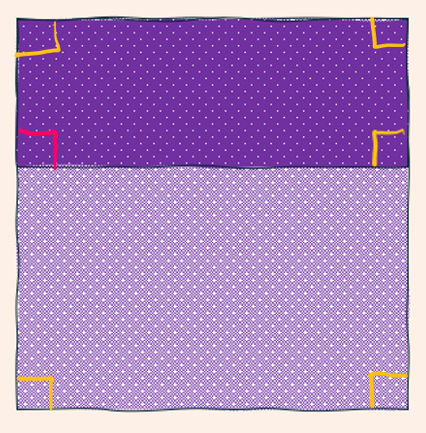
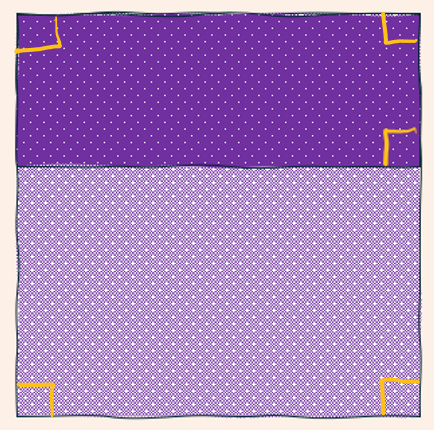
Then? Congruent triangles. We know any rectangle divided from one corner to the opposite becomes two congruent triangles. After defining our rectangle □R, we know it becomes two equally sized triangles, and those are equal in area to one another.
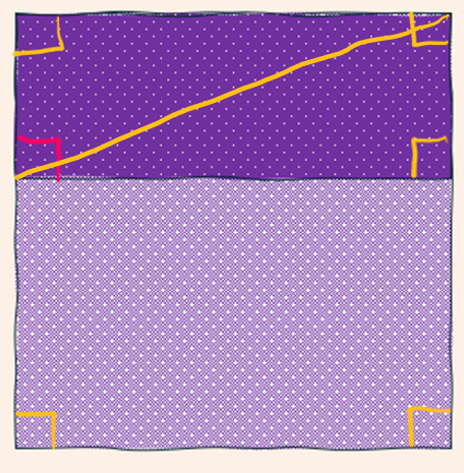
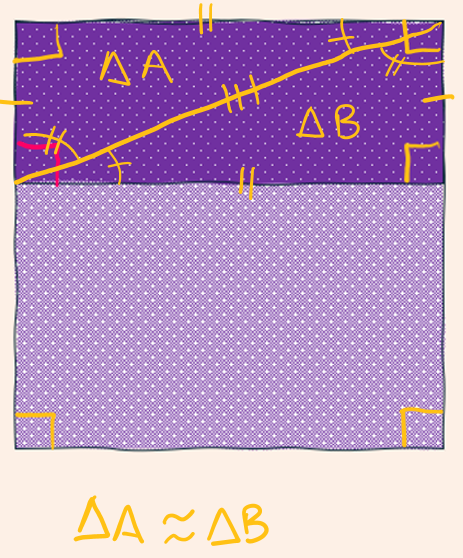
If △A = 8 and △A = △B, area of △B = 8.
Just as important for later: If △A = △B, area (△A + △B) = 8 + 8 = 16.
If we know B (8), we can eliminate two answer choices immediately. That's
Answer Choice A (△B, which is 8)
Answer Choice C (△A and △B combined, which is 16)
If area(△A + △B) = 16, □T = □S - □R = 64 - 16 = 48.
The shape created when the top 1/4 of a square is cut off is also a rectangle, and has all the properties of rectangles: 4 right angles, and the diagonal corner-to-corner line creating congruent triangles.
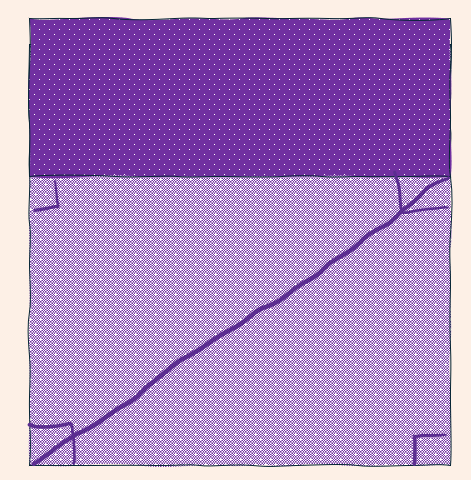
Given □T, △CD = △EF = (48 / 2 = 24), because □T cut diagonally from corner to corner creates two more congruent triangles.
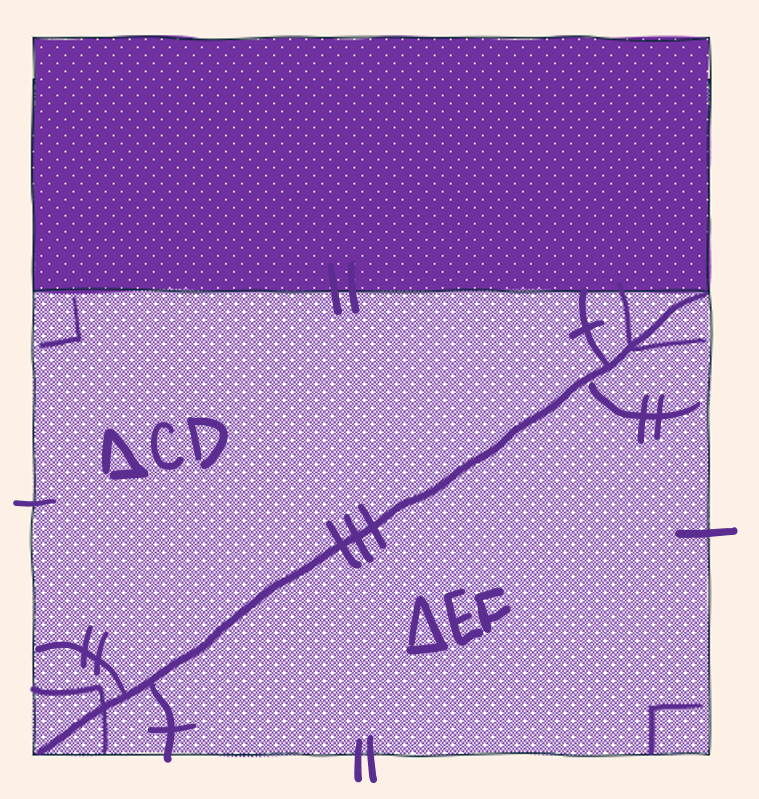
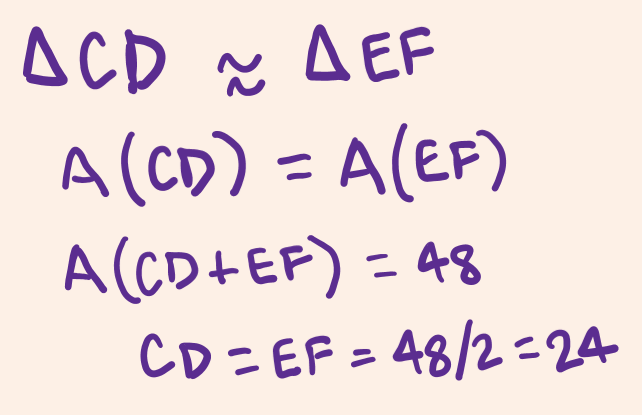
With knowing △EF =24, we are actually done! We can eliminate choices (D) (24) and (E) (8 + 24 = 32). That leaves (B) or △C. In the interest of time, you do not need to prove the last one CANNOT be found if you have proved that the other choices CAN be found.
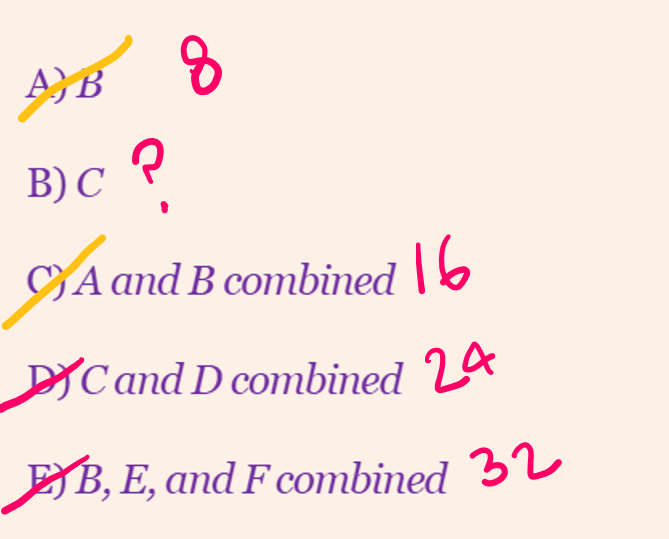
However, it's worth talking through why you cannot determine △C.
The point where you determine △CD = △EF is where we run out of rules to determine shape area. △C is a triangle with one side length bordering △B; but where does it actually intersect? It could be any value greater than 0 and less than that particular side length of △B. Even if you only included integer values, that's 7 different side length options (because the side length of △B is 8, based on the side lengths of square □S) and each produces a totally different area.
Based on this, there are actually 4 triangular regions you CANNOT determine with the information given: △C, △D, △E, and △F (though only one is by itself in an answer choice). Only by combining the two adjacent triangles in each diagonal half of □T can we produce triangular regions with knowable areas.
Problem-Solving Tips
If you solved this problem on your own or understood the steps above, but are still concerned about solving similar kinds of problems in a fast and easy way, I want to highlight a few unspoken practices and assumptions in my approach.
Use your pencil and paper. Standardized tests are moving away from pen-and-paper tests toward computers, both for adaptive test design and to stay modern with things like instant score results and anti-cheating software. However, you the student should NOT entrust all of your work to the digital screen. Studies abound showing that thinking and memorizing is better when handwritten. Apart from that, you need a free drawing canvas to solve spatial problems like this one, and nothing beats the tried and true approach of writing/drawing it on scratch paper as you go. ETS testing locations allow pencils and should either provide scratch paper or allow it if not; either way, you should be studying with your hands as well as your eyes.
Eliminate answers as soon as possible. Obvious, I know! But the act of physically (with that scratch paper) marking off options which you know to be incorrect goes a really long way toward clarifying the remaining choices and what makes them different from each other. It also increases the odds of guessing right when you have to guess, whether for reasons of no time or no earthly idea about the answer. It happens; make the best of it by crossing off any choice you eliminate immediately and checking the remaining ones when you get down to 2 or 3.
Trust the rules. Most GRE questions are testing whether you know that a hidden rule of geometry, algebra, probability, or other branches of mathematics is in effect and use it to reveal other information.
Don’t always trust your eyes. I make a habit of telling students that when not given instructions to the contrary, use your eyes or a measuring device like a ruler to estimate lengths. That does not apply in questions like this, because it’s asking whether you can PROVE the areas of each region, not what the closest likely value is. If that were the question, we could use a ruler and some fun logic to guess that the area of △C is probably between 6 and 12. But that kind of estimation is more common on Data Analysis questions, which I’ll plan to do more of in the near future.
Fun? Helpful? Confusing? Leave a note below or reach out to ask about our tutoring services. We offer frequent discounts, online seminars, and a free introductory lesson - get in touch today!
